


Our Factory
Shandongluyi Dedicatedvehicle Manufacturingco., Ltd.
Shandong Luyi dedicated vehicle Manufacturing Co., Ltd. is a designated automobile manufacturer approved by the Ministry of Industry and Information Technology of the People's Republic of China to produce all kinds of semi-trailers and commercial vehicles.
Why Choose Us
Professional teamProfessional team: Backed by over 23 years of industry experience, LUYI Automobile boasts a professional team integrating design, R&D, manufacturing and sales, delivering reliable semi-trailer solutions with profound technical expertise.
7x24 hours delivery
7x24 hours delivery: Our 7x24-hour round-the-clock support ensures you can reach us anytime. We respond promptly to resolve technical inquiries, order issues or after-sales needs, eliminating your worries.
One-stop SolutionOne-stop Solution: We offer a full-cycle one-stop service, covering initial consultation, customized production follow-up, and efficient after-sales support, simplifying your procurement process and saving time and costs.
Exporting CountriesExporting Countries: LUYI has expanded its footprint to over 80 countries across Central Asia, Africa, Southeast Asia, the Middle East and South America, gaining global recognition for quality and service.

Dump trailer is usually used to carry building materials such as sand, stones, ore, and scrap iron. LUYI 3 axle dump trailers adopt high strength steel to make it durable when loading the sand or small stones or rocks.

80Ton Dump trailer is usually used to carry building materials such as sand, stones, ore, and scrap iron.
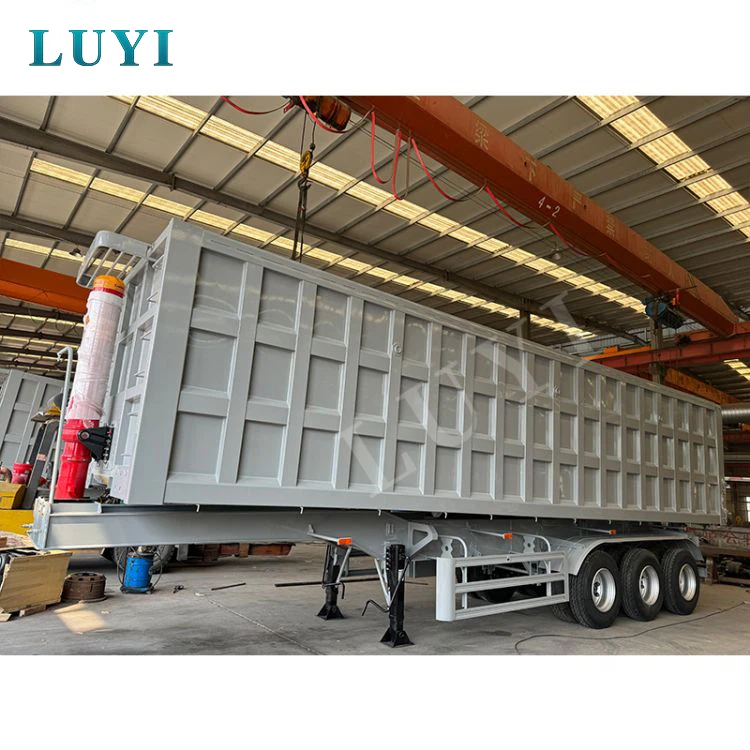
Rectangular rear dump trailer is usually used to carry building materials such as sand, stones, ore, and scrap iron.

U type dump trailer is usually used to carry building materials such as sand, stones, ore, and scrap iron.

38cbm dump truck trailer is usually used to carry building materials such as sand, stones, ore, and scrap iron.

4 axle side tipper trailer is usually used to carry building materials such as sand, stones, ore, and scrap iron.

Side dump trailer is usually used to carry building materials such as sand, stones, ore, and scrap iron.

Heavy Duty Side Tipper Trailer
Heavy duty side tipper trailer is usually used to carry building materials such as sand, stones, ore, and scrap iron.

Rear dump trailer is usually used to carry building materials such as sand, stones, ore, and scrap iron.
LUYI rear dump trailer adopt high strength steel to make it durable when loading the sand or small stones or rocks.The leaf spring is widened and thickened, the shock absorption effect is good.
What is Rear Dump Trailer
Redefining bulk material handling, the end dump trailer emerges as a game-changer with its rear-mounted tipping mechanism. Engineered to eliminate the hassle of trailer repositioning during unloading, it enables swift, precise material discharge-turning time-consuming loading/unloading tasks into streamlined operations. Beyond construction sites, its versatile design adapts seamlessly to hauling aggregates, ores, demolition debris, and more, merging rugged durability with operational efficiency to become an indispensable asset for industries demanding reliable, high-performance material transport.
Benefits of Rear Dump Trailer
With the ability to transport a wide range of materials including aggregates, soil, gravel and demolition debris, rear tipper trailers are versatile for a wide range of industries.
Unloading Efficiency
The rear dump trailer's hydraulic lifting mechanism unloads materials quickly and efficiently, increasing productivity on the jobsite.
Cost Effectiveness
Rear tipping trailers are a cost-effective solution for transporting bulk materials over short to medium distances, minimising transport costs.
Types of Rear Dump Trailer
Standard End Dump Trailers - These trailers have a single trailer frame and are commonly used for hauling construction materials such as gravel, sand, and asphalt.
Semi-Trailer End Dump Trailers - Semi-trailer end dump trailers are attached to a tractor unit and offer higher payload capacities compared to standard end dump trailers.
Application of Rear Dump Trailer

Transport materials
As a versatile workhorse for material haulage, the Rear Dump Trailer features deep beds to efficiently load, store and transport gravel, asphalt, dirt and sand-ideal for road construction, gardening and on-site logistics, with pre-operation preparation ensuring seamless deployment.
Construction sites
A staple in the construction industry, it hauls building materials and removes demolition waste to maintain organized workspaces. Equipped with durable tires to withstand harsh site conditions, pairing it with high-quality dump truck liners enhances bed protection and longevity.

Residential moving
Simplifying residential relocations and renovations, the Rear Dump Trailer accommodates old furniture, garden debris, drywall and heavy appliances in one trip. It conveniently transports waste to local disposal sites, serving as a practical solution for household cleanup needs.

Snow removing
Beyond haulage, it excels in snow removal in cold climates-acting as a snowplow, carrying salt or melting agents to de-ice roads, and hauling excess snow from job sites. Using protective bed liners prevents corrosion from melting agents, extending trailer lifespan.
1. Payload Capacity:
Offering a diverse range of models and configurations, dump semi-trailers come with varied payload capacities to suit specific transport needs. This key specification directly defines the safe volume and weight of materials the trailer can carry, making it a primary consideration when selecting a tipper.
2. Construction Materials:
Built for long-term reliability in heavy-duty conditions, dump trailers utilize high-strength steel and aluminum as primary construction materials. These materials are specially selected for their resistance to wear, corrosion, and structural fatigue, ensuring the trailer stands up to rigorous hauling demands.
3. Hydraulic System:
As the core of end-tilt trailer operation, the hydraulic system combines high-pressure pumps, cylinders, and precision control valves. It enables smooth, accurate lifting and lowering of the trailer bed, significantly enhancing the efficiency of loading and unloading processes to boost overall productivity.
4. Tipping Mechanisms:
Designed to adapt to different operational scenarios, rear dump trailers feature two main tipping types: rear-tilt for simple, direct cargo discharge and side-tilt for precise material placement. The choice of mechanism is determined by specific application requirements to optimize workflow.
5. Safety Features:
In high-risk work environments, dump trailers prioritize operator safety with essential features such as automatic tailgate locks, rollover protection systems, and rear-view cameras. These enhancements effectively reduce accident risks, ensuring safe and consistent operation at all times.
The Main Components of a Rear Dump Trailer Include
Chassis:
As the trailer's structural foundation, the steel-framed chassis bears the engine, cab, and dump body, engineered to endure extreme loads and rugged terrains inherent to heavy-duty hauling.
Engine:
The power core of the vehicle, typically a high-torque, durable diesel engine, supplies energy for both driving the truck and powering the hydraulic system that operates the dump body.
Cab:
The driver's command center, housing all controls for vehicle operation and dump body functions-designed for intuitive use to streamline workflow during demanding tasks.
Dump Body:
The material-carrying vessel, constructed from steel or aluminum and engineered for hydraulic lifting/lowering. Its size and shape are customized to match the specific bulk materials being transported.
Hydraulic System:
The driving force behind dump body movement, comprising a pump, fluid, cylinders, and valves. When activated, it directs fluid to cylinders, extending them to lift the dump body for Unloading.
Suspension System:
Balances load weight and driver comfort by absorbing shocks and vibrations via springs, shock absorbers, and related components-critical for stability on uneven surfaces.
Tires:
Heavy-duty, traction-rich tires are purpose-built to support the truck's total weight (vehicle + load) and navigate rough, debris-strewn job sites with reliability.
Tailgate:
The dump body's rear access panel, designed to open smoothly for controlled cargo release, ensuring efficient and precise unloading.
How to Choose Rear Dump Trailer
To determine safe hauling limits, reference the owner's manual for the trailer's maximum pull weight-remember this includes the trailer's own weight. Align capacity with your cargo type (lawn equipment, gravel, construction materials) and projected maximum load; a lighter trailer design translates to greater usable cargo weight for enhanced efficiency.
The hydraulic system is the dump trailer's unloading workhorse, lifting the bed via single ram, double ram, or scissor mechanisms. Scissor lifts offer superior robustness, while single rams remain popular for cost-effectiveness. Pay close attention to hydraulic mounting-this critical detail dictates whether unloading is seamless or requires manual labor.
Choose between radial and bias-ply tires, with bias-ply favored by some manufacturers for lower cost. Prioritize load rating (ranging from B to E, with E as the highest) over upfront savings, as durable, high-load tires prevent premature wear and ensure stability under heavy loads.
Axles are a critical structural component that maintains the wheel position relative to the vehicle body. The axles have to bear the trailer and cargo's entire weight, as well as the acceleration force between the vehicle and the ground. The axle also plays a central role while braking, steering, and driving the dump trailer.
Select from versatile rear gate options to match your needs: barn doors (standard for easy operation), combined barn/spreader gates (ideal for gravel spreading), truck bed gates (for longer materials), or built-in ramp gates (speeding up equipment loading). Each design optimizes functionality for specific hauling scenarios.
Park the Tow Vehicle and Trailer on a Firm and Level Surface While Loading
It may seem like this is not always possible, but it is worth taking the time to do it as well as you can. Attempting to load on a soft or uneven surface may cause the trailer to overturn, which can be extremely dangerous for both you and your trailer. Uneven surfaces can also make it very difficult to properly distribute the weight of your load. Too much load in the front portion will strain and possibly overload the hydraulic hoist. Too much load in the rear can make the trailer sway at highway speeds.
Keep the Center of Gravity as Low as Possible
Load heavy items on the floor and over the axles. Additional items should be loaded in an effort to maintain and even side-to-side weight distribution and proper tongue weight. Remember that the trailer axles carry most of the weight of the trailer and its contents, and the remainder of the total weight is carried by the tow vehicle hitch.
Use Stabilizers or Blocking When Rear Loading Equipment
Dump trailers can be a great way to move equipment like skid-steer loaders or mowers from one site to another. It is important to stabilize the rear of your trailer, though, when loading heavy equipment like this. Some trailers come equipped with rear stabilizers. If you have them, use them. If not, you can place blocks under the rear of your trailers so the weight of the cargo does not raise the front of the trailer during loading.
Only Load Material That is Intended to be Dumped
Yes, dump trailers are for dumping. You should use them to haul things that are meant to be dumped on the other end. You may find an exception if your trailer has drop sides for side-loading bulk items like palletized materials, but you should never haul livestock or people. You are putting their lives at risk, and transporting people in a trailer is also illegal. You should also never transport containers of hazardous substances or flammable liquids. Not only is this dangerous because of the substances, but it can be very difficult to maintain a safe weight distribution while moving with containers of liquid.
Be Aware of Your Surroundings When Unloading
When unloading your dump trailer, you also want to be sure your tow vehicle and trailer are on a firm, level surface for the same reasons stated above. You will also want to clear the area around the dump trailer before unloading. Be sure to place yourself in a safe location clear of the dump body while operating the dump controller. Before raising the dump body, check for overhead power lines and other obstructions. Also make sure your rear doors are open and secured with door hold backs before raising the bed.
How to Maintain Rear Dump Trailer
Regular Inspection
Routine inspections help identify potential issues before they escalate into costly repairs. Inspecting key components such as tires, brakes, and hydraulic systems can prevent unexpected downtime.
Lubrication of Moving Parts
Lubricating moving parts such as hinges, pivot points, and hydraulic cylinders reduces friction and wear, extending the lifespan of the trailer.
Cleaning and Rust Prevention
Regular cleaning and rust prevention measures help protect the trailer's structural integrity and aesthetics. Removing debris and applying protective coatings can prevent corrosion and extend the trailer's lifespan.
Our Factory


FAQ
Hot Tags: 60-ton rectangular 3-axle rear-tipping semi-trailer, China 60-ton rectangular 3-axle rear-tipping semi-trailer manufacturers, suppliers, factory, user friendly dump trailer, dump trailer for composting, dump trailer for landfilling, dump trailer for non toxic materials, dump trailer for inorganic materials, dump trailer for non flammable materials


